Assignment 2 - Reduction
DUE Thursday, April 24 at 11:59:59 PM
Overview
The objective of this assignment is to implement an optimized reduction kernel and analyze basic architectural performance properties.
Naive Reduction
In the first step, you will implement a naive reduction kernel with unoptimized thread indexing (See Reduction slides for code snippets). Recall that we discussed two types of reduction in class: naive and optimized. The naive reduction kernel implementation suffers from significant warp divergence due to naive thread indexing.
Optimized Reduction
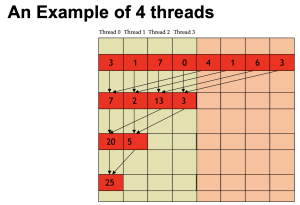
In the second step, you will implement an optimized reduction kernel with optimized thread indexing. Recall that we discussed two types of reduction in class: naive and optimized. The optimized version avoids a significant number of warp divergence. The goal is to have the thread indexing behave as shown in slide 34 of the Reduction slides.
Github Classroom
- For this lab, we will be using Github Classroom.
Please join the classroom by clicking the following link: https://classroom.github.com/a/RftMMXhl Once you join the classroom, a private github repository will automatically be created with the starter code. - Clone the git repository. There should be 5 files:
kernel.cu,main.cu,Makefile,support.cu,support.h - The size of the input array is a command line argument. If none is given, 1 million is the default size. Note that you only have to accumulate the partial sums into an array, which is copied back to the host and verified to check the final answer. To ensure consistency when grading, do not change the
sradseed value. - Complete the unoptimized and optimized reduction kernel by adding your code to
kernel.cu. There should be no changes necessary formain.cu. - You will be profiling both version of reduction to answer the questions below.
- Verify the code works
Profiling warp divergence
In order to profile the warp divergence of your reduction algorithms, two helper functions are provided in kernel.cu. The countWarpDistribution() function samples the active mask of a warp and records the number of active warps to a global counter array warpDistribution. In order to accurately measure the amount of warp divergence we have, we have to place the countWarpDistribution() function in the same basic block as the reduction operation as follows:
  for (unsigned int stride = 1; stride <= blockDim.x; stride *= 2){
    __syncthreads();
    if (t % stride == 0){
      partialSum[2*t] += partialSum[2*t+stride];
      countWarpDistribution();
    }
  }
The printWarpDistribution() function prints out the warp distribution counters. Since we only need a single printout of the warp distribution counter and every thread in the kernel runs the same code, we limit only the first thread of the first block to call the printout function. We do this by adding the following to the end of the reduction kernel:
  if(threadIdx.x == 0 && blockIdx.x == 0)
    printWarpDistribution();
This print function outputs the following:
 Warp Distribution:
W0: 0, W1: 27349, W2: 15628, W3: 0, W4: 15628, W5: 0, W6: 0, W7: 0, W8: 15628, W9: 0, W10: 0, W11: 0, W12: 0, W13: 0, W14: 0, W15: 0, W16: 15628, W17: 0, W18: 0, W19: 0, W20: 0, W21: 0, W22: 0, W23: 0, W24: 0, W25: 0, W26: 0, W27: 0, W28: 0, W29: 0, W30: 0, W31: 0, W32: 15628,
This gives a distribution of the number of warps with a given number of active threads. For example, W32 means that all 32 threads are active (i.e. no warp divergence). In this example, we also see a good number of warps that only have half of the threads active: W16:15628.
Answer the following questions:
Assume we run reduction with an input size of 100,000 and thread block size of 512 threads.
- How many thread blocks are used to perform reduction with an input size of 100,000 and thread block size of 512 threads?
- How much shared memory (in Bytes) is used by each thread block?
- Recall we do not perform a full reduction in our assignment, but rather have each thread block reduce a partial sum that will be sent back to the host. How many partial sums will be transferred back to the host?
- For the naive reduction kernel, how many steps execute without divergence? How many steps execute with divergence?
- For the optimized reduction kernel, how many steps execute without divergence? How many steps execute with divergence?
- From the results of your kernel implementations, which kernel performed better? Use profiling statistics (such as kernel execution time, the warp occupancy distribution, etc.) to support your claim.
- How does the warp occupancy distribution compare between the two Reduction implementations?
- Explain why GPUs suffer from warp divergence?
Submission
- Commit and push your completed Naive and Optimized Reduction code to the Github repository. (You only need to modify
kernel.cuand add your name toREADME.md.) - Answer the previous questions by including a report document in the repository in either PDF, Plain text, or Markdown format only. Please name your report
FirstName-LastName.pdforFirstName-LastName.txt``, etc. **To ensure we can match a repo to a student, please add your full name to theREADME.md` file.**